
How a simple programming mistake can become a major cyber security threat
Introduction
In the world of cyber security, some vulnerabilities come and go as technology evolves, whereas others remain relevant for decades because they exploit fundamental weaknesses in how software is written.
One of the most famous examples is the buffer overflow
Despite being discovered many years ago, buffer overflow vulnerabilities continue to appear in modern software and remain a common technique used by attackers to compromise systems.
Understanding what a buffer overflow is helps security professionals and developers appreciate how software vulnerabilities can lead to serious security incidents.
What Is a Buffer?
Before understanding a buffer overflow, we first need to understand what a buffer is.
A buffer is a temporary storage area in computer memory.
A good analogy is where you can imagine you are filling out a form that contains a box for your name. If the box allows 20 characters, you can write a name that fits within those limits
For example:
John Smith
fits comfortably inside the box as it is only 10 characters in length (including the space)
However
Christopher Wilson-Smythe
does not, as it is much longer at 25 characters
The same concept of data fitting into boxes exists in software. However, in this case, programs allocate a specific amount of memory to store their information
This allocated space is the buffer.
For example, a program may create a buffer that can hold 20 characters:
char username[20];This tells the computer:
Reserve enough memory to store up to 20 characters.
So, what Is a buffer overflow?
A buffer overflow occurs when a program attempts to store more data in a buffer than the buffer was designed to hold.
So in the case of our names above, the buffer holds 20 characters, but the name is 25 characters long. As such, the data exceeds the allocated memory space.
Without proper validation, the extra characters overwrite nearby memory address space
This unintended overwrite is the buffer overflow.
Why Is This Dangerous?
At first glance, overflowing memory might sound like it would simply crash a program, and sometimes it does.
However, attackers discovered that carefully crafted overflow data can do far more than cause a program to crash
A successful buffer overflow may allow an attacker to do a wide range of things, including:
- Execute malicious code
- Gain administrator privileges
- Bypass authentication
- Modify application behaviour
- Steal sensitive information
- Take complete control of a system
This transforms what appears to be a programming bug into a serious security vulnerability.
Understanding Computer Memory
To understand why buffer overflows are dangerous, it helps to know how programs use memory.
When a program runs, the memory is uses contains many different items:
- Variables
- Function information
- User data
- Return addresses
- System instructions
A simplified memory layout might look like this:
+--------------------+
| Return Address     |
+--------------------+
| Local Variables    |
+--------------------+
| Buffer             |
+--------------------+
The return address is particularly important.
When a function finishes running, the processor uses the return address to determine where the process execution should continue.
If an attacker can overwrite this value, they may be able to redirect execution to malicious instructions.
A Simple Example
Consider the following vulnerable code:
void login() {
    char password[16];

    gets(password);
}
The problem is the use of:
gets()This function reads input without checking its length.
If the user were to enter a large amount of data – e.g.:
123456789012345678901234567890the input exceeds the 16-character buffer.
These extra characters overflow into adjacent memory addresses
An attacker may deliberately construct the input so that specific memory locations are replaced with values of their choosing.
So for example, an attacker might enter
1234567890123456RunMyMalWareIn this example, the 16 characters are not important, but those after the 16th character are – these flow into other, potentially less-secure areas of memory and are executed
Stack-Based Bbuffer overflow
One of the most famous forms of buffer overflow is the stack-based buffer overflow.
The stack is a memory structure used to manage function calls.
When a function is executed, the stack stores:
- Parameters
- Local variables
- Return addresses
A simplified stack might look like this:
+--------------------+
| Return Address     |
+--------------------+
| Saved Registers    |
+--------------------+
| Buffer             |
+--------------------+
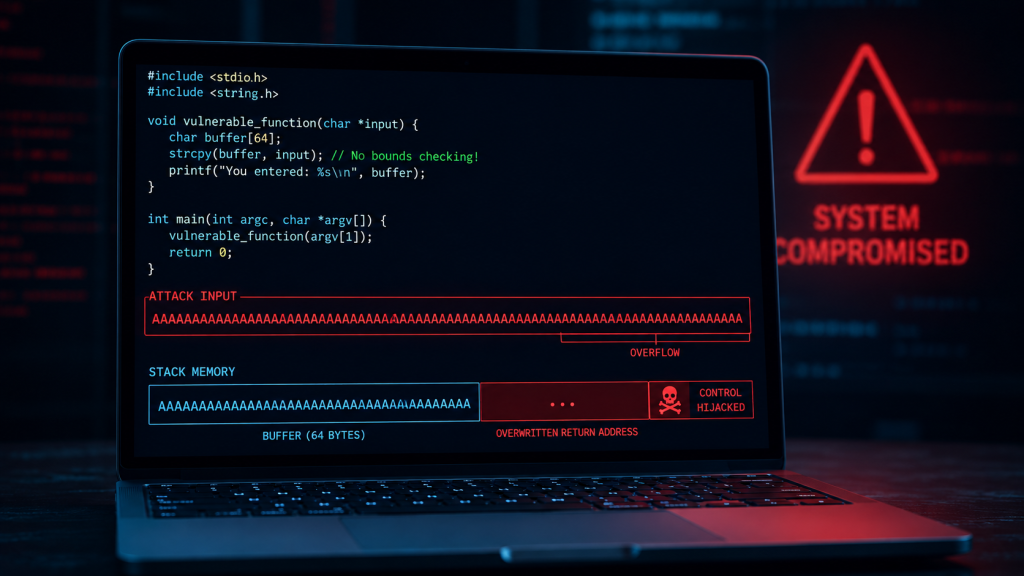
If an attacker writes beyond the end of the buffer, the overflow can eventually reach the return address.
For example:
AAAAAAAAAAAAAAAAAAAAAAAAAAAA
The repeated “A” characters overwrite memory beyond the buffer.
If enough bytes are supplied, the return address itself can be modified, so instead of returning to the legitimate program code, execution may jump somewhere else – potentially a place where malware is stored.
How attackers exploit buffer overflows
Historically, attackers often used a technique involving something called shellcode to exploit buffers
Shellcode is a small piece of machine code designed to perform malicious actions such as:
- Opening a command shell
- Creating a user account
- Downloading malware
- Establishing remote access
The attack generally followed these steps:
- Place shellcode into memory.
- Overflow the buffer.
- Overwrite the return address.
- Redirect execution to the shellcode.
When the function returns, the processor executes the attacker’s code.
Here, the vulnerable application effectively becomes a launchpad for the attack.
Famous buffer overflows
Buffer overflows have been responsible for some of the most significant security incidents in history.
Morris Worm (1988)
The Morris Worm exploited a buffer overflow vulnerability in Unix systems. It became one of the first major internet worms and disrupted thousands of computers
Code Red (2001)
The Code Red worm exploited a buffer overflow vulnerability in Microsoft IIS web servers. Within hours of the initial infection, hundreds of thousands of servers were infected.
Slammer Worm (2003)
The SQL Slammer worm used a buffer overflow vulnerability in Microsoft SQL Server. The worm spread globally in minutes and caused widespread network disruption.
Modern protections against buffer overflows
Operating systems and software developers have introduced multiple defences in an attempt to both identify, and prohibit buffer overflow attacks.
Stack Canaries
A stack canary is a special value placed between the buffer and other critical memory structures.
If the canary changes unexpectedly, the program detects a possible buffer overflow and automatically terminates preventing any further data execution
Data Execution Prevention (DEP)
DEP marks certain memory regions as non-executable – Even if an attacker places malicious code in memory, the operating system prevents it from running.
Address Space Layout Randomization (ASLR)
ASLR randomizes memory locations each time a program runs. When the program executes and asks the operating system to reserve a specific area of memory, the operating system acknowledges this, but then allocates a random memory area instead, but maintains a mapping of the requested area and the allocated area
This makes it much harder for attackers to predict where useful code or data may reside in the computer memory
Safe Programming Languages
Traditional languages such as C and C++ provide direct memory access but require developers to manage memory carefully, if a developer does not manage memory securely, buffer overflows are possible
Languages such as Rust, Java, C#, and Go include memory safety mechanisms that significantly reduce buffer overflow risks.
Microsoft are gradually re-writing Windows operating system core code in Rust to reduce the probability of buffer overflows happening
Are buffer overflows still a thing?
Absolutely, Yes.
Although modern protections have reduced their effectiveness, buffer overflows still appear regularly in:
- Operating systems
- Network devices
- Embedded systems
- Industrial control systems
- IoT devices
- Legacy applications
Security researchers continue to discover new memory corruption vulnerabilities every year, however many modern attacks involve bypassing the mitigation technologies identified above rather than relying on simple overflow techniques.
How developers can prevent buffer overflows
Developers can reduce risk by following secure coding practices.
- Validate Input Length – Always verify that user input fits within allocated memory.
- Use Safer Functions – Avoid dangerous functions such as gets(), strcpy(), and sprintf(). Use fgets(), strncpy(), and snprintf() as they are safer alternatives
- Perform Security Testing – Conduct regular Code reviews, perform static & dynamic analysis of code, and consider professional penetration testing of the systems you build
- Adopt Memory-Safe Languages such as those described earlier. Where practical, choose languages that automatically manage memory and enforce safety checks.
Why security professionals should understand buffer overflows
Even if you are not a software developer, understanding buffer overflows provides valuable insight into how cyber attacks occur.
Many advanced attack techniques evolved from the principles demonstrated by buffer overflow exploitation:
- Memory corruption
- Arbitrary code execution
- Privilege escalation
- Exploit development
Understanding buffer overflows helps security professionals:
- Assess risk
- Communicate technical threats
- Evaluate software security
- Understand vulnerability reports
- Investigate incidents
Conclusion
A buffer overflow occurs when a program writes more data into a memory buffer than it was designed to hold. What begins as a simple programming mistake can allow attackers to overwrite memory, manipulate program execution, and potentially gain complete control of a system.
Although modern operating systems include protections such as ASLR, DEP, and stack canaries, buffer overflows remain one of the most important concepts in cyber security because they demonstrate how low-level software flaws can lead to high-impact security breaches.
For developers, the lesson is clear: secure coding practices and memory safety matter. For cyber security professionals, understanding buffer overflows provides a foundation for understanding many other classes of vulnerabilities and attack techniques that continue to shape today’s threat landscape.