
The cyber security risk that already has access
Introduction
When most people think about cyber security threats, they often picture external attackers: hackers attempting to breach networks, cybercriminals launching ransomware attacks, or nation-state actors targeting sensitive information.
While these external threats are very real, some of the most damaging security incidents originate from a source much closer to home – the company’s own staff.
The people who already have legitimate access to an organisation’s systems, data, and facilities can sometimes pose a significant risk. These individuals are known as insiders, and the risks they create are referred to as insider threats.
Unlike external attackers, insiders often do not need to break through security controls. They may already possess the access, knowledge, and trust needed to cause significant damage.
What is an insider threat?
An insider threat is a security risk that originates from within an organisation. An insider is typically someone who has authorised access to company systems, facilities, data, or resources.
This may include:
- Employees
- Contractors
- Consultants
- Temporary workers
- Business partners
- Vendors
- Former employees whose access has not been removed
An insider threat occurs when one of these individuals intentionally or unintentionally compromises the organisation’s security.
In simple terms:
An insider threat is a risk posed by someone who already has legitimate access to organisational resources.
Why insider threats are different
Most cyber security controls are designed to stop unauthorised access.
Security controls such as:
- Firewalls
- Intrusion detection systems
- Antivirus software
- Multi-factor authentication
- Network segmentation
…are primarily focussed on keeping attackers out.
The challenge with insider threats is that the individual often already has permission to be there.
This creates a unique security problem – The threat may be operating within trusted systems using legitimate credentials.
As a result, insider threats can be significantly harder to detect than external attacks.
Types of insider threats
Not all insider threats are deliberately malicious. In fact, many insider incidents occur without any harmful intent. People makes mistakes, but regardless of the intent, it causes damage to the organisation, so must be prevented as much as possible
Insider threats generally fall into three categories.
Malicious insider threats
A malicious insider intentionally causes harm to the organisation.
Their motivations may include:
- Financial gain
- Revenge
- Personal grievances
- Ideological beliefs
- Corporate espionage
Examples include:
- Stealing customer data
- Selling confidential information
- Deleting company records
- Sabotaging systems
- Assisting external attackers
Because these individuals often understand internal systems and processes, they can be particularly dangerous.
Negligent insider threats
Negligent insiders do not intend to cause harm, however, their actions create security risks.
Examples include:
- Clicking phishing links
- Sharing passwords
- Sending sensitive data to the wrong recipient
- Using weak passwords
- Misconfiguring systems
- Ignoring security policies
Many organisations experience more incidents from negligence than from malicious insiders
Even highly skilled employees can make mistakes.
Compromised insider threats
A compromised insider occurs when an external attacker gains control of a legitimate user’s account or device. The employee may not even realise they have been compromised.
Examples include:
- Stolen credentials
- Malware infections
- Account takeovers
- Session hijacking
From a security monitoring perspective, the attacker may appear to be a legitimate employee because they are using valid credentials.
This makes detection particularly challenging.
Who can become an insider threat?
One common misconception is that insider threats only involve disgruntled employees, but the reality is that insider risks can originate from almost anyone with access.
Examples include:
- Employees – The most obvious insider category.
Employees often have broad access to systems and data. - Contractors – Contractors may have temporary access to critical systems.
Security oversight is sometimes less rigorous for non-permanent staff. - Third-Party Vendors – External suppliers frequently require access to organisational environments.
Compromising a vendor account may provide access to sensitive resources. - Former Employees – If access rights are not removed promptly, former employees may continue to access systems after leaving the organisation.
This creates unnecessary risk.
Why insider threats are so dangerous
Insider threats are dangerous because insiders possess advantages that external attackers typically lack.
- Legitimate access – Insiders already have access to systems, applications, databases, and networks. This eliminates many of the barriers external attackers must overcome.
- Organisational knowledge – insiders often have a good understanding of business processes, security controls, sensitive data locations, and the overall technical infrastructure. This knowledge can help them avoid detection.
- Trust – One of the most important factors. Employees and contractors are generally trusted so their actions may not attract immediate suspicion.
- Reduced detection – Security monitoring tools often focus on identifying unusual external activity. Legitimate user actions may be overlooked, even when they are harmful.
- Access to sensitive information – Insiders frequently have access to data such as customer records, financial information, intellectual property, strategic plans, and other employee data. This access increases the potential impact of an incident.
Common Insider Threat Scenarios
Insider incidents can take many forms.
- Data theft – An employee downloads confidential customer information before leaving the company. These data may later be sold, shared with competitors, or used for personal gain
- Intellectual property theft – Sensitive business information such as product designs, source code for applications, research data, or trade secrets may be copied and removed from the organisation.
- Sabotage – A disgruntled employee intentionally damages systems by targeting elements of the CIA triad
Examples include:- Accessing sensitive data (Confidentiality)
- Deleting data (Availability)
- Disrupting services (Availability
- Altering records (Integrity)
- Credential sharing – Employees share accounts or passwords with colleagues. This weakens accountability and increases risk.
- Accidental aata exposure – An employee mistakenly uploads confidential files to a public location. No malicious intent exists, but the consequences may still be severe.
- Shadow IT – Employees use unauthorised software or cloud services without security approval. This can expose company data to additional risks.
Real-World Consequences of Insider Threats
The impact of insider incidents can be significant and long-lasting to the organisation.
- Financial losses – Organisations may incur costs related to various factors linked to insider threat activity. Losses linked to incident response, recovery efforts, legal action, or regulatory penalties can be highly damaging to a business that has not factored this into their rick management plan
- Reputational damage – Customers expect organisations to protect sensitive information. A publicised insider incident can erode trust, leading to a migration of customers to other rival organisations. Trust takes an age to build, but can be lost in a minute
- Operational disruption – Critical systems may become unavailable or unreliable. This can impact productivity and service delivery. Disruption like this can affect Service Level Agreements (SLAs), leading to further financial losses due to breach of contract
- Regulatory consequences – Data protection regulations often require organisations to protect sensitive information. Failure to do so may result in fines and enforcement action. Serious breaches of GDPR can have devastating consequences due to the financial penalties which could be incurred. Some ransomware attackers set their ransom fee slightly lower than the potential regulatory penalty, indicting to the target organisation that it would be cheaper to keep quiet and pay the ransom, then suffer the regulatory fines.
- Loss of competitive advantage – The theft of intellectual property can damage long-term business performance. Such losses can set organisations back years in terms of their research, and competative advantage
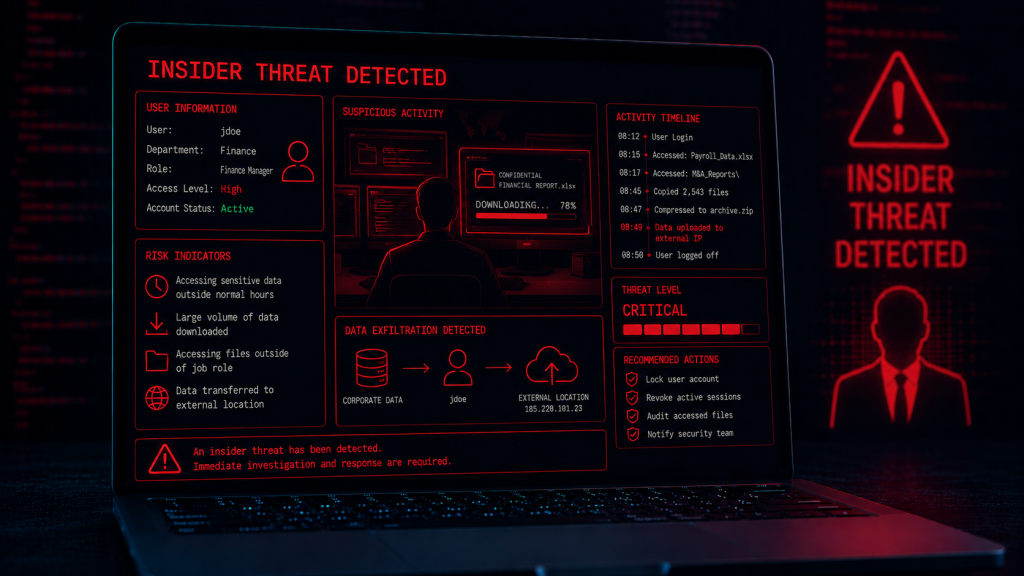
Warning signs of insider threat activity
While no single indicator proves malicious intent, certain behaviours may warrant investigation.
Examples include:
- Unusual access patterns
- Excessive file downloads
- Accessing data unrelated to job duties
- Repeated policy violations
- Attempts to bypass security controls
- Unauthorised use of external storage devices
- Unexpected after-hours activity
- Accessing systems shortly before resignation
It is important to remember that these indicators should be evaluated carefully and fairly.
Most unusual behaviour has a legitimate explanation.
How organisations can reduce insider threat risk
Effective insider threat management requires a combination of technology, processes, and culture. All of which require close management and analysis
- Conduct thorough onboarding processes – Personnel security starts before an employee joins the organisation. Thorough screening of candidates, reference checking, and potentially security screening helps ensure the organisation only employs the right people for their business.
- Apply the principle of least privilege – Employees should only have access to the systems and data required for their role. Limiting access reduces potential damage.
- Implement Role-Based Access Control (RBAC) – Permissions should be assigned based on job responsibilities. Access should be reviewed regularly.
- Reassess security access periodically – Regular reviews of staff access rights can help limit access creep – this is where staff members, over time acquire access rights that are inappropriate for their role.
- Monitor user activity – Organisations should monitor for unusual behaviour, including large file transfers, unusual login activity, access to sensitive systems. Monitoring should be proportionate and compliant with applicable privacy requirements. One mechanism which can be employed here is to ensure staff take their allocated holiday allowance. If a staff member is under suspicion, monitor their activity closely, and also whilst they are on leave – If the suspicious activity continues whilst they are on leave, then the blame might be from elsewhere.
- Conduct security awareness training – Employees should understand common security topics such as Phishing attacks, data handling requirements, company security policies, and incident reporting procedures. Many insider incidents can be prevented through education.
- Establish clear policies – Employees should understand acceptable use requirements and security expectations. Policies should be communicated clearly and consistently.
- Implement Data Loss Prevention (DLP) – DLP solutions help identify and prevent unauthorised data transfers. Examples of DLP include Email monitoring, file transfer controls, and cloud storage monitoring
- Use Multi-Factor Authentication (MFA) – MFA reduces the risk of compromised accounts being used by attackers.
- Maintain strong offboarding processes – When employees leave ensure all account access is disabled promptly and any access rights should be removed from all services. Company assets such as phones, laptops, and RSA keys should be returned. Failure to offboard properly can create unnecessary risk.
- Foster a positive security culture – Employees are more likely to follow security practices when they understand their importance and feel supported. Security should be viewed as a shared responsibility rather than solely an IT issue.
Balancing Security and Trust
One challenge of insider threat management is balancing security with employee trust. Overly intrusive monitoring can damage morale, reduce productivity, and create privacy concerns.
Organisations should aim to protect sensitive assets, respect employee privacy, maintain transparency, and apply controls fairly.
Effective insider threat programmes focus on risk management rather than suspicion.
The Future of Insider Threats
As organisations adopt a more dynamic way of working with remote working, cloud computing, hybrid environments, and ever increasing third-party integrations, the insider threat landscape will continue to evolve.
Employees now access systems from multiple locations and devices, often outside traditional network boundaries.
This increases the importance of security controls such as Identity and Access Management (IAM), behavioural monitoring and analysis, and continuous security awareness
The insider threat challenge is no longer confined to the office environment, because the traditional office environment no longer exists
Conclusion
Insider threats represent one of the most complex and challenging areas of cyber security because they involve individuals who already possess legitimate access to organisational resources. These threats may be malicious, negligent, or the result of compromised accounts, but all have the potential to cause significant harm.
Unlike external attackers, insiders often understand business processes, security controls, and the location of sensitive information. This knowledge, combined with legitimate access, makes insider incidents particularly difficult to detect and prevent.
By implementing strong access controls, monitoring user activity, providing security awareness training, enforcing least privilege principles, and fostering a positive security culture, organisations can significantly reduce the risks posed by insider threats while maintaining trust and productivity.
In modern cyber security, protecting against external attackers is only part of the challenge. Organisations must also recognise that some of the most significant risks may already exist within their own trusted environments.