
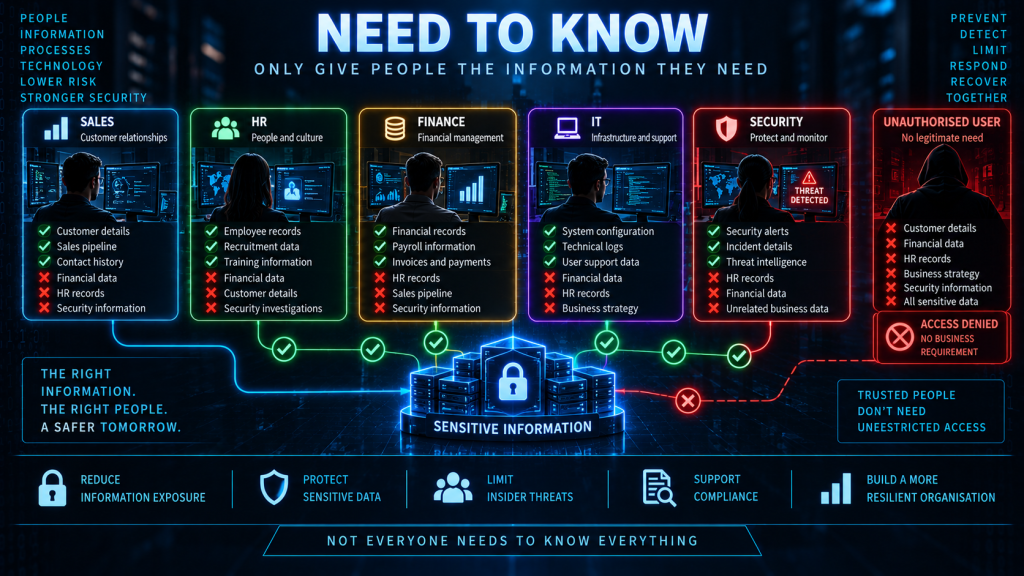
Imagine an organisation has a confidential document containing the details of a major business acquisition.
Several employees may be trusted enough to work for the organisation, and some may have access to the company’s document management system.
But that doesn’t mean they should all be able to read the acquisition documents.
The people who actually need the information to perform their jobs should have access to it, but everyone else doesn’t need to know about it (yet!)
This is the principle of Need to Know.
The concept is simple:
A person should only have access to information if they have a legitimate business requirement to know that information.
Need to Know is a fundamental security principle used to limit the unnecessary exposure of sensitive information.
What is Need to Know?
Need to Know means restricting access to information based on whether an individual genuinely requires that information to perform their role or a specific task.
It isn’t enough for someone to be:
- An employee
- A manager
- An administrator
- A member of the IT department
- A trusted individual
- Someone who could technically access the information
They need a legitimate reason to have access.
For example, imagine a company has confidential information about employee salaries.
- A payroll administrator may need access.
- A member of the HR department may need access to some of the information.
- An employee’s manager may need to know their own team’s salary information.
But a network administrator generally has no reason to read the payroll data simply because they administer the servers on which the data is stored.
The network administrator may be highly trusted, but They simply don’t need to know about the information to do their job
Why is Need to Know important?
The more people who have access to sensitive information, the greater the opportunity for that information to be:
- Accidentally disclosed
- Deliberately misused
- Stolen
- Copied
- Modified
- Exposed through a compromised account
Need to Know reduces the number of people who can access sensitive information in the first place.
Consider a document containing highly confidential information.
If 1,000 employees can access it, there are potentially 1,000 accounts that could be compromised or misused, but if only 10 employees genuinely require the document, limiting access to those 10 people significantly reduces the exposure.
This is sometimes described as reducing the information attack surface.
Need to Know isn’t about trust
One of the most important aspects of Need to Know is that it isn’t necessarily about whether someone is trustworthy or not.
Imagine that Alice and Bob are both completely trustworthy employees.
Alice works in Finance, and Bob works in IT.
A confidential financial report is relevant to Alice’s work but not to Bob’s – Bob doesn’t need access to it for him to fulfil his role objectives.
The organisation isn’t saying “We don’t trust Bob.“, It’s saying “Bob doesn’t need this information to perform his job.”
This distinction is important.
Security shouldn’t depend entirely on whether people are considered trustworthy – Instead, access should be based on legitimate requirements.
Need to Know vs Least Privilege
Need to Know is closely related to Least Privilege, but the two principles address slightly different things.
Least Privilege asks “What can this person or system do?” – The objective is to provide only the permissions required to perform a task.
Need to Know asks “What information does this person actually need to access?” – The objective is to prevent unnecessary exposure of information.
A useful way to remember the distinction is:
Least Privilege limits what you can do.
Need to Know limits what you can see.
In practice however, the two principles often overlap.
Need to Know and data classification
Need to Know works particularly well alongside data classification.
An organisation can classify information according to its sensitivity.
For example:
| Classification | Example |
|---|---|
| Public | Published company information |
| Internal | Internal procedures |
| Confidential | Business plans |
| Highly Confidential | Customer or employee sensitive data |
The more sensitive the information, the more carefully access should be controlled.
Not every employee needs to know everything.
Need to Know in the workplace
Let’s imagine the scenario of an employee investigation. Suppose an organisation is investigating allegations of serious misconduct by a staff member.
Several people may be involved:
- HR
- Management
- Legal
- Security
- The employee’s manager
But that doesn’t mean everyone in the organisation should know about the investigation specifics.
The people directly involved have a legitimate need to know – other employees don’t.
This helps protect both the organisation and the individuals involved.
Need to Know in cybersecurity
Need to Know has an important role in cybersecurity because security teams often deal with highly sensitive information.
For example:
- Passwords and credentials
- Encryption keys
- Vulnerability information
- Security configurations
- Incident reports
- Threat intelligence
- Security investigations
- Details of security weaknesses
A security analyst may need access to some of this information, but not necessarily all of it.
For example, a help-desk employee might need to know that a particular account has been disabled, but they probably don’t need to know that the account was disabled because “we believe the user’s credentials were compromised by a particular threat actor using a specific attack technique.“
The second piece of information may be restricted to the security team.
Need to Know and incident response
Need to Know can become particularly important during a security incident.
Imagine an organisation discovers that it has suffered a major data breach. There may be sensitive information about:
- The affected systems
- Vulnerabilities
- Compromised accounts
- Customers
- Employees
- Attackers
- Security investigations
The incident response team may need extensive access to this information, but not everyone in the organisation necessarily needs to see the investigation details. They might not even need to know that an investigation is even taking place.
Information can therefore be distributed according to the responsibilities of the people involved.
Different people receive different information based on what they need to perform their role.
Need to Know and administrators
A common misconception is that if someone is an administrator, they need access to everything.
That isn’t necessarily true – An administrator may need powerful technical privileges without needing access to the information stored within the systems they administer.
For example, a database administrator may need to:
- Create databases
- Configure storage
- Manage database performance
- Apply patches
- Configure replication
But they may not need unrestricted access to the actual customer records.
Where practical, technical controls can separate administrative access from data access.
This is particularly valuable when dealing with sensitive information.
Technical implementation
Need to Know isn’t simply a policy statement – It can be implemented through technical controls.
Access control – Systems can restrict access to particular users or groups.
Role-Based Access Control – RBAC can associate information access with a user’s role.
Attribute-Based Access Control (ABAC) – More complex environments may use Attribute-Based Access Control.
Here, access decisions can take into account attributes such as:
- User role
- Department
- Location
- Security clearance
- Device
- Resource classification
- Time
- Business context
For example, a rule could state:
Allow access if the user is a member of the Finance department, is using a managed device and the requested document is classified as Finance Confidential.
This allows more detailed access decisions.
Need to Know and databases
Databases provide many opportunities to implement Need to Know.
A user might be able to access a database but only see the records relevant to their job.
Techniques such as database permissions, views and row-level security can help restrict what users can access.
This can be particularly useful when a large database contains many different types of information.
Need to Know and file systems
The same principle applies to ordinary files.
Imagine a shared drive containing:
- Public Data
- Marketing Data
- Finance Data
- HR Data
- Legal Data
- Security Data
It would be unnecessary for every employee to have access to every folder.
Instead Access Control can restrict access as such:
- Marketing Team → Marketing
- Finance Team → Finance
- HR Team → HR
- Legal Team → Legal
- Security Team → Security
The organisation limits access based on the information required by each group.
Need to Know and cloud storage
Cloud services make need to know both easier and more complicated.
Cloud platforms can provide extremely granular access controls, but organisations may also have thousands of:
- Users
- Groups
- Applications
- Files
- Databases
- Storage locations
A poorly designed permission structure can result in sensitive information being accessible to far more people than intended.
Organisations therefore need to understand – Who can access this information, and why?
This is particularly important when sharing information between departments, external contractors or third-party organisations.
Need to Know and third parties
Need to Know also applies outside the organisation.
Suppose an organisation hires an external contractor to maintain a particular application.
The contractor may need:
- Access to the application
- Technical documentation
- Relevant logs
- Specific configuration information
They probably don’t need access to:
- Payroll
- HR records
- Other applications
- Unrelated customer databases
- Internal security investigations
The contractor should receive only the information required to perform the agreed work.
This helps reduce the risk created by third-party access.
Need to Know and temporary access
Need to Know doesn’t necessarily mean permanent access – Someone may need information for a particular task but not afterwards.
For example, a security analyst is investigating an incident so they are granted access to a sensitive dataset.
When the investigation finishes, their temporary access is removed.
This combines Need to Know with the principle of Just-in-Time access.
The concept can therefore be expressed as:
The right information, to the right person, for the right reason, for the right amount of time.
Need to Know and “just because you can”
One of the biggest problems in information security is the assumption that “If I can access it, I must be allowed to look at it.” – That isn’t necessarily true.
A system administrator might technically have the ability to access a user’s mailbox, but that doesn’t mean they should open it and read the emails without a legitimate reason.
Similarly, a database administrator might technically be able to query customer records, but that doesn’t mean they should browse through them out of curiosity.
Need to Know establishes an important boundary between:
Technical capability and Legitimate business requirement.
Need to Know and auditing
Access controls are much more effective when combined with logging and auditing.
An organisation can record:
- Who accessed information
- What they accessed
- When they accessed it
- What they did
- Whether the access was unusual
For example:
10:14 — Finance user accessed payroll report
10:16 — Finance user exported report
10:18 — Security analyst accessed audit log
10:22 — Network administrator attempted to access payroll data
The final event might warrant investigation because it doesn’t appear consistent with the administrator’s normal responsibilities.
Monitoring can therefore help identify inappropriate access.
The danger of excessive Need to Know
Need to Know also needs to be implemented sensibly. If information is restricted so heavily that people cannot perform their jobs, employees may create workarounds.
The objective is not to make information impossible to access, it is to ensure that access is appropriate to the person’s responsibilities.
Security controls need to support the business rather than preventing legitimate work.
Need to Know and Zero Trust
Need to Know fits naturally with Zero Trust.
Where zero trust asks whether a particular access request should be allowed, need to know helps determine whether the person has a legitimate reason to access the information.
The fact that someone is authenticated doesn’t automatically mean they should have access to everything.
Need to Know and Defence in Depth
Need to Know is another layer in a defence-in-depth strategy.
Imagine an attacker compromises an employee’s account.
The account has successfully passed authentication, but the attacker can only access information associated with that employee’s role.
- They attempt to access sensitive HR records – Access is denied.
- They attempt to access Finance data – Access is denied.
- They attempt to access security investigations – Access is denied.
The account has been compromised, but the attacker’s access to information is limited.
This reduces the potential impact of the compromise.
Need to Know and the CIA Triad
Need to Know has a particularly obvious relationship with Confidentiality. Restricting access to information reduces the likelihood of unauthorised disclosure.
But it can also support the other two elements.
Confidentiality – Only people who need information can access it.
Integrity – Fewer people and systems have access to modify sensitive information.
Availability – Restricting access can reduce the possibility of unauthorised users deleting or disrupting information.
The strongest relationship is therefore with confidentiality, but the principle can support all three elements of the CIA triad.
Implementing Need to Know
A practical Need to Know programme can involve several steps.
- Identify sensitive information – Determine what information needs additional protection.
- Classify the information – Apply appropriate classifications based on sensitivity.
- Identify who needs access – Determine which roles genuinely require each type of information.
- Define access rules – Use groups, roles, permissions and policies to enforce those requirements.
- Remove unnecessary access -Don’t leave access in place simply because someone technically has a reason to access the system.
- Use temporary access where appropriate – Provide access for a specific task and remove it afterwards.
- Monitor access – Log and review access to sensitive information.
- Review regularly – People change roles, projects end and business requirements change.
Access requirements should therefore be reassessed periodically.
In summary
The Need to Know principle states that people should only have access to information that they genuinely require to perform their role or complete a specific task.
It helps organisations:
- Reduce unnecessary information exposure
- Limit the impact of compromised accounts
- Reduce insider-threat risk
- Protect confidential information
- Support data classification
- Improve access control
- Reduce the information attack surface
- Improve accountability
It can be implemented using:
- Access controls
- RBAC
- ABAC
- Database permissions
- File permissions
- Data classification
- Temporary access
- Just-in-Time access
- Logging and auditing
- Regular access reviews
The key distinction is:
Least Privilege asks what you should be able to do.
Need to Know asks what you actually need to know.
An administrator might legitimately have the ability to administer a database. That doesn’t automatically mean they need to read every record in it.
An employee might be trusted with confidential information. That doesn’t mean they need access to all confidential information.
A secure organisation therefore doesn’t simply ask “Can this person access the information?”. It asks “Why does this person need to access the information?”
If there is no good answer, they probably don’t need access.
Give people the information they need — and nothing they don’t.