
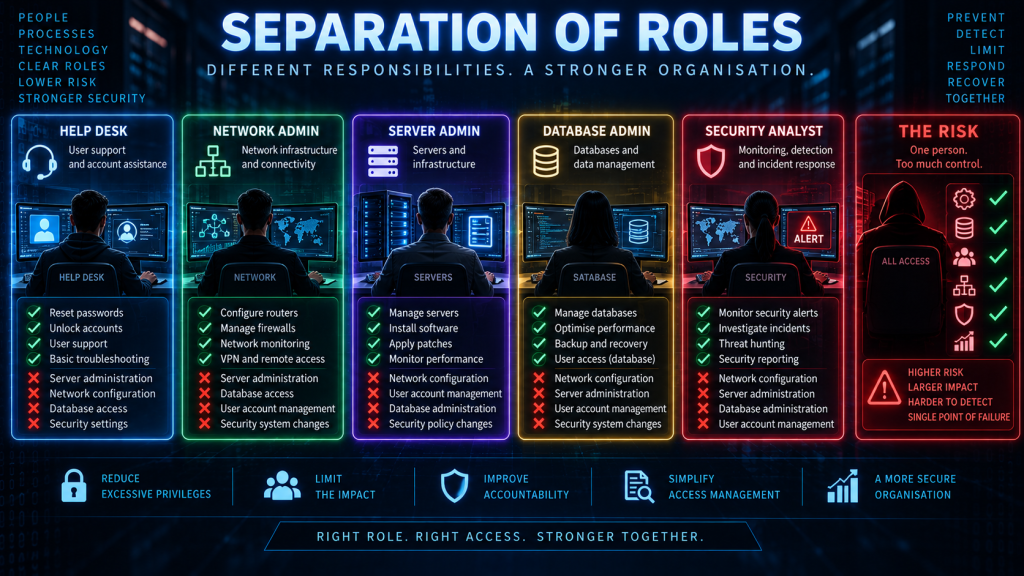
In a small organisation, one person might look after almost everything – They might manage the network, administer servers, create user accounts, maintain security systems and even investigate security incidents.
In a small environment, this may be unavoidable.
But as an organisation grows, giving one person responsibility for every part of the IT environment creates a significant security risk – A person who has control over the network, identity systems and security monitoring could potentially make changes without anyone else knowing.
A compromised account with those same privileges could give an attacker enormous control over the organisation.
This is where the principle of separation of roles becomes important.
The basic idea is:
Different responsibilities should be assigned to different roles, with each role receiving the permissions necessary to perform its particular function.
Separation of roles helps organisations control access, reduce excessive privileges and limit the consequences of a compromised account.
What is Separation of Roles?
Separation of roles means dividing an organisation’s responsibilities into distinct roles, with each role having its own defined capabilities and permissions.
For example, an IT department might contain:
- Help Desk
- Server Administration
- Network Administration
- Database Administration
- Security Operations
Each role has a different purpose.
- A help-desk technician might be able to reset a user’s password.
- A network administrator might be able to configure switches and firewalls.
- A database administrator might be able to manage databases.
- A security analyst might be able to investigate security alerts.
None of these roles necessarily needs access to everything.
The objective is to ensure that people receive the capabilities appropriate to their responsibilities.
Why is Separation of Roles important?
Without separation of roles, organisations can end up with people having far more access than they actually need.
Consider an administrator who has unrestricted access to:
- User accounts
- Network infrastructure
- Servers
- Databases
- Security systems
- Backups
- Audit logs
That person effectively has control over the entire IT environment.
Even if the administrator is completely trustworthy, their account becomes a highly valuable target for attackers – If their credentials are compromised, the attacker may inherit all of those privileges.
Separation of roles reduces this concentration of authority.
Separation of Roles vs Separation of Duties
This is an important distinction – Whilst the two concepts are related but they aren’t identical.
Separation of roles – Separates different areas of responsibility.
For example: Network administration is separate from database administration.
Separation of duties – Separates different steps within a sensitive process.
For example: The person who creates a payment cannot also approve that payment.
A useful way to remember the difference is:
Roles describe who is responsible for what.
Duties describe how a particular process is divided between people.
Role-Based Access Control
One of the most common ways of implementing separation of roles is through Role-Based Access Control (RBAC).
Instead of assigning individual permissions to every user, an organisation defines roles.
For example:
| Role | Example permissions |
|---|---|
| Help Desk | Password resets, account support |
| Network Administrator | Network devices and firewalls |
| Server Administrator | Server management |
| Database Administrator | Database management |
| Security Analyst | Security monitoring |
| Developer | Development environments and source code |
Users are then assigned to the appropriate roles.
The permissions follow the role, rather than being individually assigned without structure.
Why roles are better than individual permissions
Imagine an organisation with 5,000 employees.
If permissions are assigned individually, administrators potentially have thousands of individual access relationships to manage – As you can imagine, this quickly becomes difficult to control.
However an organisation only needs to define a small number of roles and the capabilities those roles can have.
Lets now imagine a new staff member that is assigned the Network Administrator role.
Their permissions are inherited from that role template.
If they leave the role, the role assignment can be removed from that staff member.
This makes access management more consistent and easier to audit.
Separation of roles and least privilege
Separation of roles works closely with the principle of least privilege.
Least privilege asks What permissions does this person need?
Separation of roles asks What responsibilities should this person have?
For example, a security analyst may need access to the organisation’s SIEM.
They probably don’t need permission to:
- Modify the production database
- Configure network routers
- Create domain administrator accounts
- Change firewall rules
Giving them those permissions would exceed the requirements of their role.
The two principles therefore reinforce each other:
- Separation of Roles – Define responsibility
- Least Privilege – Grants only the required permissions
Security roles
Security teams themselves often benefit from separation of roles.
A security department might include:
- Security analysts
- Incident responders
- Vulnerability analysts
- Security engineers
- Threat hunters
- Security architects
- Governance and compliance specialists
Their responsibilities may overlap, but they don’t necessarily require identical access.
For example:
- Security Analyst – Primarily investigates alerts and suspicious activity.
- Security Engineer – Designs and maintains security technologies.
- Incident Responder – Investigates and contains security incidents.
- Security Architect – Designs the organisation’s overall security architecture.
Giving every member of the security team unrestricted access to every system simply because they work in “security” would undermine least privilege.
Administrative roles
Modern operating systems and cloud platforms often provide very granular administrative roles. For example, instead of creating one account with unrestricted administrator access, an organisation might create separate Admin roles such as:
- User Administrator – Manage user accounts
- Network Administrator – Manage networking
- Server Administrator – Manage servers
- Security Administrator – Manage security controls
- Audit Administrator – Review logs and activity
- Backup Administrator – Performs backups of data
- Restore Administrator – Preforms back restoration
This reduces the amount of authority concentrated in any one account.
It can also make investigations easier because actions can be associated with specific responsibilities.
Cloud environments
Separation of roles becomes particularly important in cloud environments.
Cloud platforms can contain enormous numbers of resources and permissions.
An organisation might have separate roles for:
- Identity management
- Storage administration
- Database administration
- Network administration
- Security management
- Billing
- Application deployment
- Auditing
This prevents every administrator from automatically having complete control over the entire cloud environment.
Separation of roles and privileged accounts
Privileged accounts deserve particular attention.
An organisation may have hundreds of administrative functions, but that doesn’t mean every administrator needs every privilege.
This approach creates boundaries between privileged responsibilities.
If the Network Administrator account is compromised, the attacker doesn’t automatically receive the privileges of the Server Administrator or Security Administrator.
Limiting the blast radius
This is one of the biggest security benefits of separation of roles.
Imagine an attacker compromises an account belonging to a database administrator. If that account also has unrestricted network and identity administration privileges, the attacker may be able to take control of a large part of the organisation.
If the database administrator has only database-related privileges, the attacker’s options are much more limited.
The database might still be compromised, but the blast radius is smaller.
This is the same fundamental principle as with least privilege:
A compromised account shouldn’t automatically become a compromised organisation.
Separation of roles and lateral movement
Attackers frequently attempt to move from one compromised system to another.
If administrative responsibilities are properly separated, obtaining one set of credentials may not provide access to everything.
This is one reason separation of roles is an important part of defence in depth.
Separation of roles and monitoring
Different roles also make security monitoring more meaningful.
Imagine an account belonging to a security analyst suddenly making changes to firewall rules. That activity may deserve investigation because it is unusual for that role.
Similarly, if a database administrator attempts to create a new domain administrator account, the activity should potentially generate an alert.
Security monitoring can therefore consider not only “What did the account do?”, but also “Is this something that account’s role would normally be expected to do?”
This provides useful context for detecting compromised accounts and insider threats.
What about small organisations?
As with separation of duties, small organisations can find separation of roles difficult.
A company with five employees may not be able to employ separate:
- Network administrators
- Server administrators
- Database administrators
- Security engineers
- Identity administrators
One person may have to perform several roles.
The principle can still be applied where practical.
For example, an organisation might:
- Use separate privileged accounts
- Restrict administrative permissions
- Use managed services
- Require external approval for sensitive changes
- Use logging and monitoring
- Perform periodic access reviews
- Use automated controls
The objective isn’t perfect separation – It’s to avoid unnecessary concentration of privilege.
Separation of roles and accountability
Clearly defined roles also make it easier to establish accountability.
If everyone has administrator privileges, it can be difficult to determine who should be responsible for a particular action, but when responsibilities are clearly divided, activity can be associated with the appropriate role.
For example:
09:12 — Network Admin changed firewall rule

09:18 — Security Analyst investigated alert

09:31 — Server Admin patched server

09:42 — Auditor reviewed change
This creates a clearer audit trail.
It also discourages inappropriate use of privileges because administrators know that their actions are attributable to them.
Role design should reflect business responsibilities
A common mistake is to design roles purely around technology. Instead, roles should reflect what people actually need to do.
For example, simply creating a role called “IT Administrator” and giving it access to everything may be convenient, but it defeats much of the purpose of role separation.
A better approach might be:
IT Department roles:
- Help Desk administrators
- Endpoint Management administrators
- Network administrators
- Server administrators
- Database administrators
- Identity administrators
- Security administrators
The exact structure will vary between organisations, but the important thing is to create meaningful boundaries.
Avoiding excessive role complexity
There is another potential problem with roles. If an organisation creates hundreds or thousands of highly specialised roles, access management can become difficult to understand.
For example:
NetworkAdmin-ReadOnly
NetworkAdmin-ReadOnly-East
NetworkAdmin-ReadOnly-East-Production
NetworkAdmin-ReadOnly-East-Production-Temporary
...
At some point, the role structure itself becomes a management problem.
Good role design therefore aims for a balance:
Roles should be sufficiently granular to enforce security, but sufficiently simple to remain understandable and manageable.
Implementing Separation of Roles
A practical implementation can involve several steps.
- Identify responsibilities – Determine what activities need to be performed within the organisation.
- Group related responsibilities – Create logical roles around those activities.
- Define permissions – Determine what each role actually needs to perform its responsibilities.
- Apply least privilege – Remove permissions that aren’t necessary.
- Separate highly sensitive responsibilities – Avoid creating roles with unnecessarily broad authority.
- Assign users to roles – Users receive access based on their job responsibilities.
- Monitor privileged activity – Log important actions and investigate unexpected behaviour.
- Review roles regularly – Business requirements change, and roles need to evolve with them.
- Remove obsolete access – When people change roles, their old role assignments should be removed.
Separation of Roles in the bigger picture
Separation of roles is another building block in the wider security model.
CIA Triad – Separating responsibilities can help protect confidentiality, integrity and availability by limiting who can access and modify systems.
Defence in Depth – Different roles create additional boundaries that an attacker must overcome.
Least Privilege – Each role receives only the permissions required for its responsibilities.
Separation of Duties – Sensitive processes can be divided between people occupying different roles.
Zero Trust – Access is explicitly evaluated rather than automatically granted simply because someone belongs to the organisation or is inside its network.
Together, these principles create layers of control around an organisation’s systems and information.
In summary
Separation of roles is the practice of dividing responsibilities between distinct roles and giving each role only the permissions required to perform its particular function.
It helps organisations:
- Reduce excessive privileges
- Limit the impact of compromised accounts
- Reduce lateral movement
- Protect sensitive systems
- Improve accountability
- Simplify access management
- Support least privilege
- Provide additional defence in depth
Common examples include:
- Network administration separate from server administration
- Database administration separate from application development
- Security monitoring separate from system administration
- Identity administration separate from other administrative functions
- Help-desk responsibilities separate from security administration
The key distinction is worth remembering:
Separation of roles defines who is responsible for what.
Separation of duties determines how sensitive processes are divided between those roles.
Neither principle assumes that employees are untrustworthy. Instead, both recognise a fundamental security reality:
The fewer unnecessary privileges and responsibilities concentrated in one place, the less damage a mistake, malicious insider or compromised account can cause.
A secure organisation doesn’t just ask whether someone is trustworthy.
It asks:
“What role do they have, what do they actually need to do, and what should they be prevented from doing?”