
What is ransomware? Attacks, trends, and real-world cases
Ransomware has evolved into one of the most damaging and profitable forms of cybercrime. From global enterprises to small businesses, no organisation is immune. Modern ransomware attacks are no longer just about encrypting files—they involve data theft, extortion, and sophisticated intrusion techniques.
This guide explains how ransomware works, how attackers gain access, and what recent real-world cases reveal about the evolving threat landscape.
Introduction
What is ransomware?
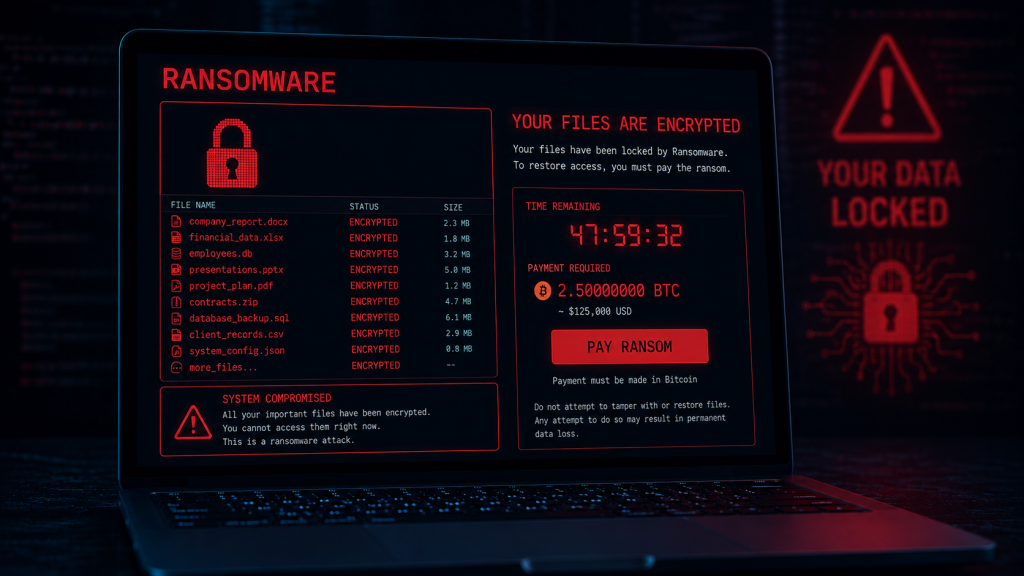
Ransomware is a type of malware that blocks access to systems or data -typically by encrypting files -and demands payment (a ransom) for restoration.
Modern ransomware operations often include:
- Double extortion (data encryption + data leak threats)
- Triple extortion (adding DDoS or customer pressure)
- Ransomware-as-a-Service (RaaS) models
How ransomware attacks work
A typical ransomware attack follows a structured lifecycle:
1. Initial Access
Attackers gain entry through:
- Phishing emails
- Compromised credentials
- Exposed remote services (e.g., RDP)
- Malicious USB devices or downloads
2. Privilege Escalation & Lateral Movement
Once inside, attackers:
- Escalate privileges
- Move across the network
- Disable security controls
3. Data Exfiltration
Sensitive data is stolen before encryption begins.
4. Encryption & Ransom Demand
Files are encrypted, and victims are pressured to pay—often in cryptocurrency.
Common entry points for ransomware
Remote Access Exploits
- RDP vulnerabilities remain a top ransomware entry vector
- Weak configurations and phishing via
.rdpfiles increase risk
Related: Microsoft RDP security updates
Physical & Hardware-Based Attacks
- Malicious USB devices can deliver payloads
- Hardware-level attacks can bypass traditional defenses
Related: USB security risks
Network-Based Attacks
- Man-in-the-middle (MITM) attacks can intercept credentials
- Wi-Fi exploitation can lead to initial access
Related: AirSnitch Wi-Fi attack
Exploit Kits & Malware Delivery
- Advanced exploit kits target vulnerabilities across devices
- Often used as initial infection vectors for ransomware
Related: Coruna iOS exploit kit
Real-world ransomware: LockBit Case Study
LockBit is one of the most active ransomware groups in recent years and a prime example of how modern ransomware operates.
Key characteristics:
- Operates as a RaaS platform
- Uses automated attack tooling
- Targets large enterprises and infrastructure
- Frequently leaks stolen data to increase pressure
Lessons from LockBit attacks:
- Speed and automation are increasing
- Data theft is now standard practice
- Even large organisations are vulnerable
Related: Lockbit, Lockbit claim Boeing scalp, Op cronos – Lockbit takedown
Ransomware in the wider threat landscape
Government and law enforcement reports consistently highlight ransomware as a top-tier threat.
Key trends include:
- Growth in organised cybercrime groups
- Increased targeting of critical infrastructure
- Expansion of cybercrime marketplaces
Related: NCA Strategic Assessment
How to protect against ransomware
Effective ransomware defence requires a layered approach:
Technical Controls
- Patch systems regularly
- Disable unnecessary remote access
- Use endpoint detection and response (EDR)
Identity & Access Security
- Adopt passwordless authentication (passkeys)
- Enforce multi-factor authentication (MFA)
- Monitor for credential misuse
Related: Google banish passwords, The future of no passwords, Ditch the password
Network Security
- Segment networks
- Monitor traffic for anomalies
- Restrict lateral movement
Backup & Recovery
- Maintain offline backups
- Test recovery procedures regularly
The future of ransomware
Ransomware is evolving toward:
- Fully automated attack chains
- AI-assisted phishing and exploitation
- Increased targeting of supply chains
- Greater use of stealth and persistence
Defending against ransomware requires continuous adaptation, not one-time fixes.
Final Thoughts
Ransomware is no longer just a technical issue – it’s a business risk, a national security concern, and a constantly evolving threat.
By understanding how attacks work – and learning from real-world cases – you can significantly reduce your risk.
If you are unfortunate to be targeted by a ransomware attack, then help is at hand. The NoMoreRansom website contains help and advice for victims, along with hundreds of known ransomware decryption keys